
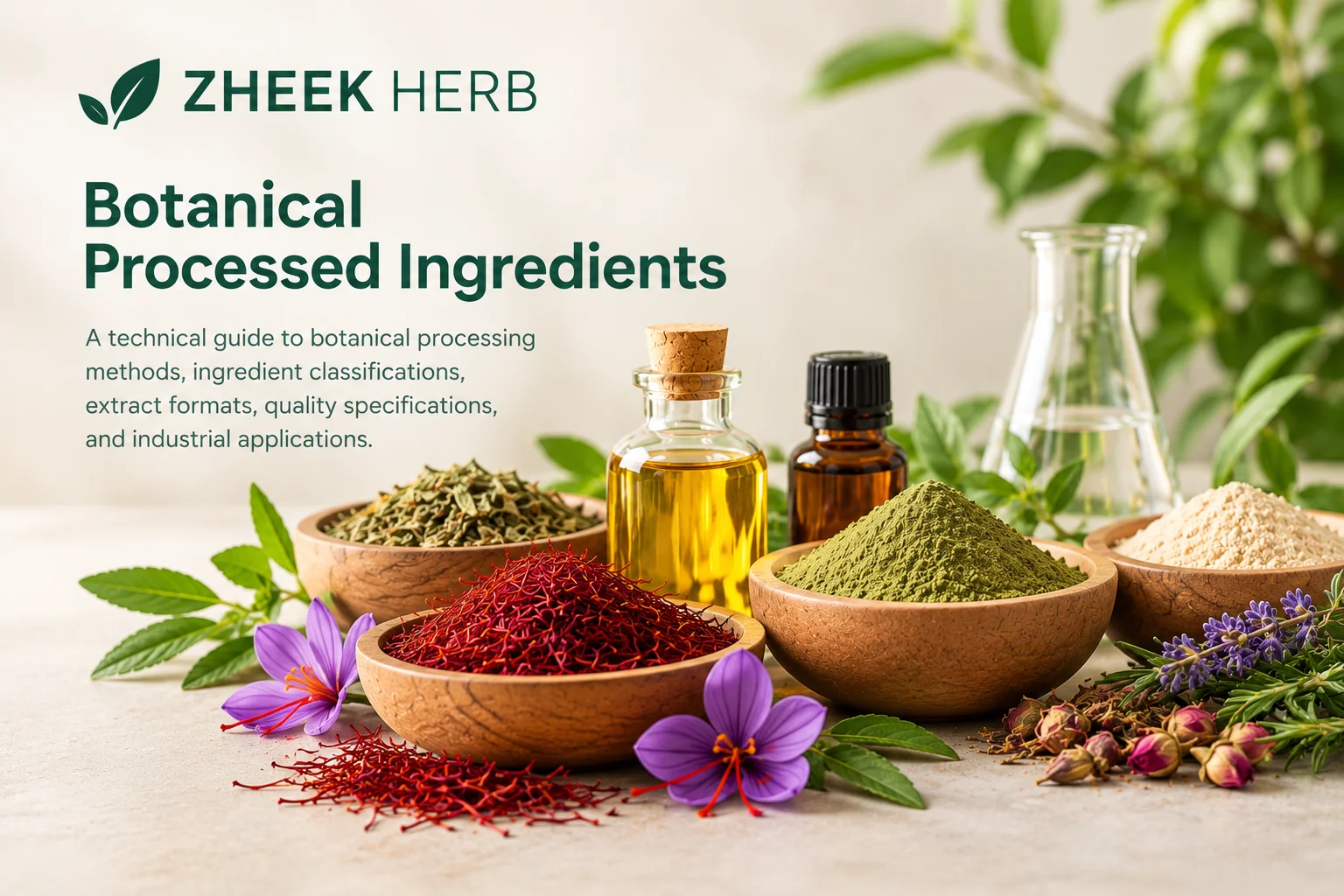
Botanical Processed Ingredients: A Technical Guide to Processing & Classifications
Explore botanical ingredient types, processing methods, quality factors, industrial applications, and B2B documentation requirements.
Botanical Processed Ingredients
A technical guide to botanical processing methods, ingredient classifications, extract formats, quality specifications, and industrial applications for manufacturers sourcing plant-derived raw materials for food, cosmetic, pharmaceutical, and nutraceutical formulations.
Botanical Extracts Essential Oils Distillates Powder Extracts Liquid Extracts Quality Control B2B Sourcing
Looking for botanical ingredients by application? Explore our botanical extract range and ingredient solutions for the food industry, cosmetic industry, and pharmaceutical industry.
What Are Botanical Processed Ingredients?
Botanical processed ingredients are plant-derived materials that have undergone physical, mechanical, or extraction processes to produce ingredients suitable for specific manufacturing and formulation requirements. Depending on the plant species, plant part, processing method, and intended application, these ingredients may be supplied as powders, liquid extracts, essential oils, hydrosols, distillates, or other concentrated botanical preparations.
Unlike unprocessed herbs, processed botanical ingredients are prepared to meet defined requirements for composition, physical properties, compatibility, and quality documentation. Their specifications depend on the intended application and the requirements agreed upon between the supplier and the buyer.
Common categories of processed botanical ingredients:
- Botanical extracts: Preparations obtained by transferring selected plant constituents into a suitable extraction medium.
- Powder extracts: Dried botanical preparations developed for applications requiring a solid ingredient format.
- Liquid extracts: Liquid botanical preparations used in formulations that require a liquid ingredient.
- Essential oils: Concentrated volatile aromatic materials obtained from suitable botanical sources, commonly through distillation or other appropriate extraction methods.
- Hydrosols and distillates: Water-based products associated with distillation processes, with composition depending on the plant and production method.
- Standardized extracts: Extracts manufactured and tested against a defined specification for one or more selected constituents or analytical markers.
Botanical Ingredient Classification Matrix
| Ingredient Category | Typical Format | Processing Approach | Potential Applications |
|---|---|---|---|
| Botanical Extracts | Liquid, viscous, or dry | Solvent-based or other suitable extraction methods | Food, cosmetics, nutraceuticals, pharmaceutical research |
| Powder Extracts | Dry powder | Extraction followed by suitable drying and finishing | Capsules, tablets, sachets, dry blends |
| Liquid Extracts | Liquid | Extraction, filtration, and formulation as required | Liquid supplements, beverages, topical formulations |
| Essential Oils | Volatile aromatic liquid | Steam distillation, hydrodistillation, or another suitable method | Fragrance, personal care, and selected food applications |
| Hydrosols and Distillates | Water-based liquid | Distillation and separation of the resulting fractions | Cosmetic formulations, aromatic products, selected specialty applications |
| Standardized Extracts | Powder or liquid | Controlled extraction with analytical verification | Formulations requiring defined marker specifications |
How Botanical Processing Works
Botanical processing is a sequence of operations designed to transform suitable plant material into an ingredient that meets the target product specification. The exact workflow varies according to the botanical species, plant part, desired constituents, processing technology, and final application.
1. Raw Material Selection and Identification
Processing begins with selecting and identifying the botanical raw material. Important considerations include the scientific name, plant part, geographical origin where relevant, harvest conditions, supplier documentation, and suitability for the intended use.
Key control points:
- Confirm botanical identity and the plant part used.
- Review incoming-material specifications and supplier documentation.
- Assess moisture, visible foreign matter, and other relevant quality parameters.
- Apply risk-based testing for microbiological contamination, pesticides, heavy metals, or other relevant contaminants.
2. Cleaning, Sorting, and Size Reduction
Depending on the incoming material, cleaning and sorting may be used to remove unwanted foreign matter. Cutting, grinding, or milling can reduce particle size and improve consistency during subsequent processing. The appropriate particle size depends on the plant material and the production method.
Important considerations:
- Maintain botanical identity and prevent material mix-ups.
- Control particle size where it affects extraction performance.
- Limit unnecessary exposure to heat, moisture, oxygen, or light when these may affect sensitive constituents.
- Use suitable handling and storage conditions before processing.
3. Extraction and Separation
Extraction is used to transfer selected constituents from botanical material into a suitable medium or fraction. The extraction method is selected according to the target compounds, their physical and chemical properties, the plant matrix, and the intended product specification.
Common processing approaches:
- Water extraction: Uses water as the extraction medium and may be suitable for selected water-extractable constituents.
- Hydroalcoholic extraction: Uses a water-alcohol mixture where appropriate for the target constituents.
- Other solvent extraction: Uses a suitable solvent selected according to process requirements and applicable regulations.
- Steam distillation: Commonly used to recover volatile aromatic constituents from suitable botanical materials.
- Mechanical processing: Used for certain plant-derived products where pressing, separation, or other physical operations are appropriate.
The extraction method alone does not establish the quality, purity, safety, or suitability of the final ingredient. These characteristics must be assessed against the product specification and relevant analytical results.
4. Filtration, Concentration, and Purification
Following extraction, additional operations may be required to remove suspended solids, reduce liquid volume, separate selected fractions, or adjust the composition of the ingredient. The specific operations depend on the process design and the intended characteristics of the final product.
Possible processing steps:
- Filtration or clarification to remove suspended particles.
- Concentration to achieve a defined solids content or concentration range.
- Separation of selected fractions where required.
- Additional purification steps when supported by the product specification.
5. Drying and Powder Production
When a dry ingredient is required, a liquid extract may undergo a suitable drying process. The selected technology and operating conditions can influence moisture content, flow properties, dispersibility, constituent retention, and storage stability.
Powder specifications may include appearance, identification, moisture or loss on drying, particle-size characteristics, bulk density, solubility or dispersibility where relevant, and analytical markers when required.
6. Standardization and Blending
Standardization is used when an ingredient must meet a defined specification for one or more selected constituents or analytical markers. Depending on the material and manufacturing process, achieving a target specification may involve controlled blending or other suitable processing steps.
Standardization may involve:
- Defining the target analytical marker and acceptance range.
- Selecting an appropriate validated or fit-for-purpose analytical method.
- Evaluating batch-to-batch variation.
- Documenting the final result in the product specification and batch documentation.
A standardized extract is not automatically equivalent to an isolated pure compound. Buyers should confirm whether the specification refers to a marker concentration, a group of constituents, an extract ratio, or the purity of an isolated compound.
7. Packaging, Storage, and Batch Release
Finished botanical ingredients should be packed in materials suitable for their physical and chemical properties. Packaging and storage conditions should be selected to protect the ingredient against relevant risks, which may include moisture, light, oxygen, contamination, or temperature variation.
Before release, the batch should be assessed against the agreed specification and applicable quality requirements. Documentation should identify the material, batch, test results, and any relevant storage or handling instructions.
Key Factors That Influence Botanical Ingredient Quality
Finished ingredient quality depends on more than the extraction method. Raw material variability, process conditions, analytical methods, storage, and packaging can all influence the final characteristics of a botanical preparation.
| Quality Factor | Why It Matters | What Buyers Should Review |
|---|---|---|
| Botanical Identity | Helps confirm the intended species and plant material. | Scientific name, plant part, identification method |
| Active Markers | Can support consistency where a defined constituent is relevant. | Marker definition, assay method, acceptance range |
| Moisture Content | May affect handling, stability, and susceptibility to deterioration. | Moisture or loss-on-drying specification |
| Contaminants | May affect suitability for the intended application. | Risk-based microbiological and chemical testing |
| Residual Solvents | Relevant when solvents are used during processing. | Applicable limits and analytical results |
| Physical Properties | Influence processing, mixing, and formulation performance. | Particle size, flow, dispersibility, viscosity, or density as relevant |
| Stability | Supports appropriate shelf-life and storage decisions. | Stability information, packaging, storage conditions |
| Traceability | Supports batch identification and quality investigations. | Batch number, source records, COA, and related documentation |
Processed Botanical Ingredients by Industry
Food and Beverage Industry
Food manufacturers may use botanical extracts, essential oils, distillates, and other plant-derived ingredients for flavor, aroma, color, or other formulation functions, depending on the ingredient and its permitted use. Selection should consider the food matrix, processing conditions, sensory profile, dosage requirements, and applicable food regulations.
Common formulation considerations:
- Compatibility with the product's pH, water content, and processing temperature.
- Flavor, aroma, color, and potential interactions with other ingredients.
- Solubility or dispersibility in the intended formulation.
- Food-grade specifications and market-specific regulatory requirements.
Cosmetic and Personal Care Industry
Cosmetic formulators use selected botanical extracts, essential oils, and distillates in products such as creams, lotions, cleansers, and other personal care formulations. Suitability depends on ingredient identity, composition, formulation compatibility, intended use, and the applicable cosmetic safety and regulatory framework.
Common formulation considerations:
- Compatibility with water-based, oil-based, or emulsion systems.
- Color, odor, solubility, and stability within the finished formulation.
- Microbiological quality and suitable preservation strategies where relevant.
- Ingredient labeling, safety assessment, and market-specific compliance.
Pharmaceutical and Nutraceutical Applications
Pharmaceutical research and nutraceutical manufacturers may require botanical materials with defined identity, composition, and analytical specifications. Requirements vary significantly depending on whether the ingredient is intended for research, a dietary supplement, a regulated medicinal product, or another use category.
Common sourcing considerations:
- Defined botanical identity and manufacturing specifications.
- Appropriate analytical methods for relevant constituents or markers.
- Batch-specific certificates of analysis and contaminant testing.
- Traceability, stability information, and documentation appropriate to the intended use.
Botanical raw materials are not automatically approved pharmaceutical ingredients. Buyers should verify the required quality system, regulatory status, and documentation for the specific product and target market.
Powder Extracts vs. Liquid Extracts
Powder and liquid formats can serve different manufacturing needs. The appropriate choice depends on the formulation, processing equipment, target concentration, handling requirements, and stability of the botanical material.
| Parameter | Powder Extract | Liquid Extract |
|---|---|---|
| Physical Form | Dry solid | Liquid preparation |
| Common Uses | Dry blends, capsules, tablets, sachets | Liquid formulations, selected beverages, and topical products |
| Handling | Requires control of moisture, dust, and powder flow where relevant | Requires suitable liquid handling and storage conditions |
| Formulation Checks | Dispersibility, particle size, moisture, and compatibility | Solvent system, concentration, viscosity, and compatibility |
| Storage | Protect from relevant moisture, light, and temperature risks | Protect according to the ingredient's stability and packaging requirements |
Neither format is universally superior. A powder may be more practical for dry formulations, while a liquid may simplify incorporation into selected liquid systems. The supplier's specification and compatibility testing should guide the final decision.
How to Read a Botanical Extract Specification
A product specification describes the defined characteristics and acceptance criteria of an ingredient. Buyers should review the full specification rather than relying only on the product name or a single advertised percentage.
Important specification fields include:
- Botanical name: The scientific name of the source plant.
- Plant part: The portion used, such as root, leaf, flower, seed, or fruit.
- Ingredient type: Extract, powder extract, liquid extract, essential oil, distillate, or isolated constituent.
- Extraction details: Relevant extraction medium or process information, where disclosed and applicable.
- Extract ratio: The stated relationship between starting botanical material and extract, where applicable. This should not be treated as equivalent to active-compound purity.
- Analytical marker: The constituent or group of constituents used to assess the material.
- Assay method: The analytical method used to determine the reported result.
- Contaminant limits: Relevant microbiological, chemical, or physical limits for the intended application.
- Storage and shelf life: The specified storage conditions and supporting shelf-life information.
Quality Documentation and Batch Verification
Technical documentation helps buyers evaluate whether a botanical ingredient meets their purchasing specification and intended-use requirements. The documents required will depend on the product category, supplier's quality system, destination market, and application.
| Document | Purpose | Buyer Review |
|---|---|---|
| Certificate of Analysis (COA) | Reports specified analytical results for a product or batch. | Confirm batch identity, test results, methods, and acceptance criteria. |
| Technical Data Sheet (TDS) | Summarizes technical properties and product specifications. | Check format, composition, physical properties, and recommended handling. |
| Safety Data Sheet (SDS) | Communicates relevant chemical and handling safety information where applicable. | Review classification, handling, storage, and transport information. |
| Contaminant Test Results | Provide evidence for selected contaminant specifications. | Check the tested parameters, methods, limits, and reported results. |
| Traceability Records | Support identification of the material and its batch history. | Confirm batch codes and relevant source documentation. |
Analytical methods should be appropriate for the ingredient and the parameter being measured. For example, HPLC may be suitable for quantifying selected non-volatile constituents, while GC-based methods may be appropriate for many volatile compounds. The method, sample preparation, reference standards, and reporting basis all influence how results should be interpreted.
Common Mistakes When Sourcing Processed Botanical Ingredients
- Choosing by percentage alone: A stated percentage is meaningful only when the measured constituent, analytical method, and reporting basis are clear.
- Confusing extract ratio with purity: These describe different characteristics and should not be used interchangeably.
- Ignoring the intended application: A material suitable for one industry may not meet the requirements of another.
- Requesting no batch documentation: Without appropriate records, buyers may struggle to verify consistency and compliance.
- Assuming every botanical extract is water-soluble: Solubility and dispersibility depend on the composition of the ingredient and the formulation system.
- Overlooking storage requirements: Packaging and storage conditions can affect ingredient quality over time.
- Assuming regulatory approval is universal: Requirements vary by ingredient, use category, claims, and destination market.
Buyer Checklist: Before You Order
- Confirm the botanical species and plant part.
- Define the required ingredient category and physical format.
- Specify the intended application and target market.
- Identify the required active marker, assay method, or other critical quality parameters.
- Review the specification, COA, and relevant contaminant testing.
- Confirm solubility, dispersibility, and compatibility requirements where relevant.
- Check packaging, storage conditions, shelf-life information, and batch traceability.
- Discuss minimum order quantity, lead time, sample availability, and delivery requirements.
- Verify the regulatory and labeling requirements applicable to the final product.
Why Choose a Reliable Botanical Ingredient Supplier?
For B2B manufacturers, supplier selection should consider product consistency, technical transparency, communication, documentation, and the ability to meet agreed specifications. A reliable sourcing process helps reduce uncertainty during ingredient qualification and supports more effective collaboration between procurement, quality assurance, and formulation teams.
| Selection Criteria | What to Look For |
|---|---|
| Product Consistency | Clear specifications and appropriate batch-level verification. |
| Technical Support | Access to product information and clarification of technical requirements. |
| Quality Documentation | Relevant COA, technical data, and supporting test results. |
| Traceability | Clear product identification and batch documentation. |
| Supply Planning | Transparent communication about availability, MOQ, lead time, and packaging. |
ZHEEK HERB supplies botanical ingredients for B2B applications. Buyers should confirm the specifications, documentation, availability, and intended-use suitability of each product directly with the export and technical team before placing an order.
How to Select the Right Processed Botanical Ingredient
- Define the final application. Identify whether the ingredient will be used in food, cosmetics, nutraceuticals, pharmaceutical research, fragrance, or another application.
- Choose the ingredient format. Compare powder, liquid, essential oil, distillate, or another suitable format against your formulation and manufacturing process.
- Set the specification. Define botanical identity, target constituents, analytical methods, physical properties, and relevant contaminant limits.
- Review the technical documents. Request the applicable product specification, COA, and supporting documentation needed by your quality team.
- Evaluate compatibility. Where necessary, assess solubility, dispersibility, sensory properties, and stability in your own formulation.
- Confirm commercial details. Agree on quantity, packaging, lead time, storage requirements, and delivery arrangements before ordering.
Frequently Asked Questions
What is the difference between a botanical extract and a standardized extract?
A botanical extract is a preparation obtained from plant material through an extraction process. A standardized extract is specified and assessed against a defined level or range for one or more selected constituents or analytical markers.
Is an extract ratio the same as active-compound purity?
No. An extract ratio describes the relationship between the starting botanical material and the resulting extract, according to the stated calculation basis. Active-compound purity or marker content refers to a measured constituent and should be interpreted using the relevant analytical method.
How do I choose between powder and liquid extracts?
Powder extracts may be suitable for dry blends, capsules, tablets, and sachets, while liquid extracts may be more convenient for selected liquid formulations. The choice depends on formulation compatibility, stability, processing requirements, and the product specification.
Which analytical methods are used to test botanical ingredients?
The appropriate method depends on the constituent or quality parameter being measured. HPLC is commonly used for selected non-volatile compounds, while GC-based methods are often used for volatile constituents. Buyers should confirm the method and reporting basis for each specification.
What documents should I request from a botanical ingredient supplier?
Depending on the ingredient and intended use, buyers may request a product specification, batch-specific COA, technical data sheet, applicable safety data sheet, and relevant contaminant or stability information.
Can the same botanical ingredient be used in food, cosmetics, and pharmaceutical products?
Not automatically. Each application may have different quality, safety, regulatory, and documentation requirements. Suitability must be assessed for the specific ingredient, product category, and destination market.
What should I check before purchasing botanical ingredients in bulk?
Confirm botanical identity, ingredient format, specification, analytical methods, batch documentation, contaminant limits, packaging, storage conditions, minimum order quantity, and lead time. Also verify that the ingredient is suitable for your intended application and market.
Explore more botanical ingredient resources in the ZHEEK Knowledge Center, or browse our botanical extract range.