
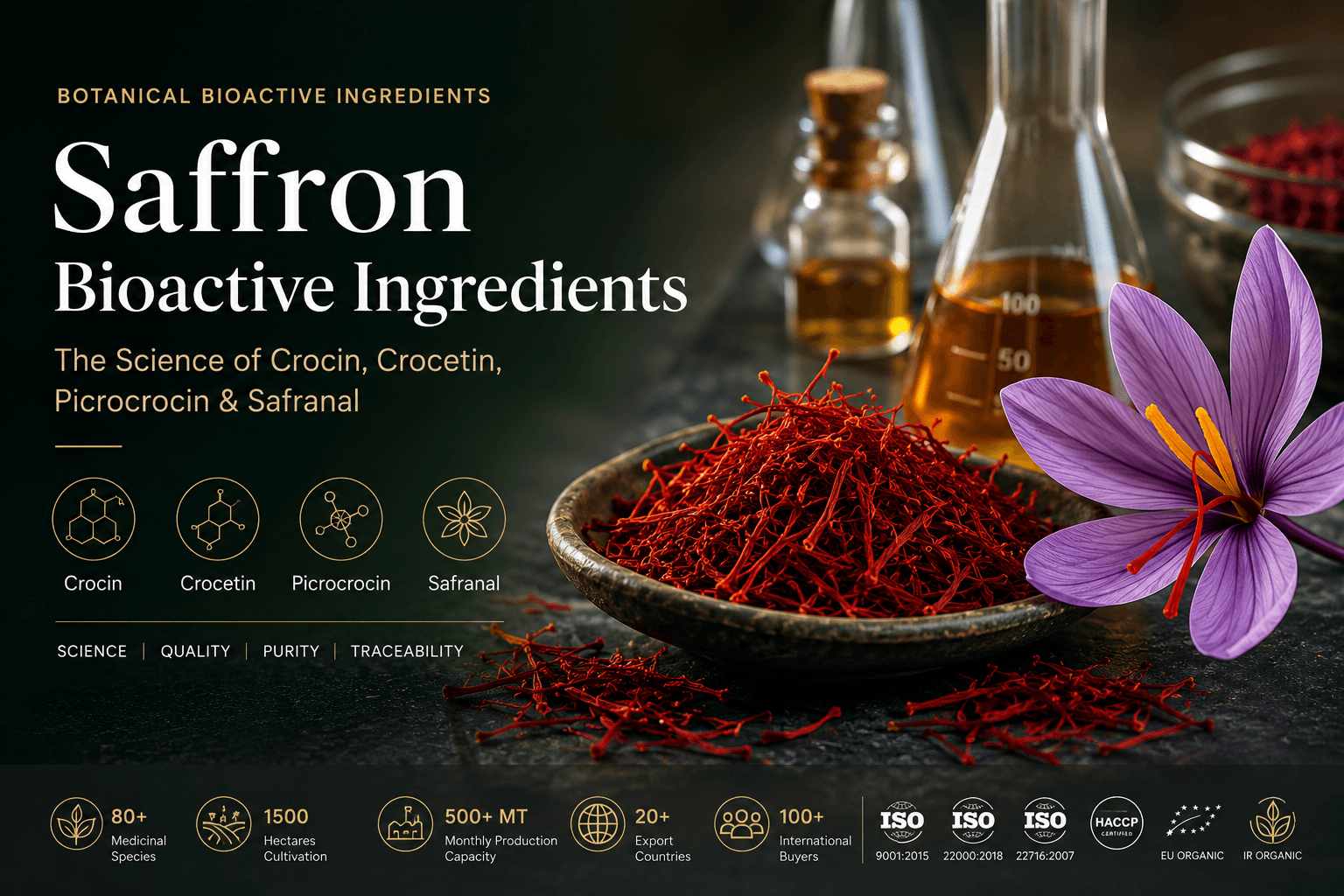
Saffron Bioactive Ingredients: Crocin, Crocetin & Safranal
Explore saffron chemical composition through crocin, crocetin, picrocrocin and safranal. Compare their roles, stability, analysis and bulk ingredient applications.
Botanical Bioactive Ingredients
A buyer's guide to sourcing standardized saffron actives — Crocin, Safranal, Powder and Liquid Extract — for pharmaceutical, nutraceutical, cosmetic, fragrance, food, and veterinary formulation, matched to grade, application, and industry specification.
Crocin Safranal Pharmaceutical Nutraceutical Cosmetic Fragrance Food & Beverage Veterinary
Looking for the underlying chemistry instead — how Crocin, Crocetin, Picrocrocin and Safranal form and are analytically verified? See our Saffron Bioactive Ingredients: Crocin, Crocetin & Safranal guide.
What Is Industrial Grade Saffron ingredients?
Industrial saffron ingredients refers to standardized botanical actives (crocin, safranal, picrocrocin) produced under GMP conditions for B2B formulators.
Key specifications for Standardized products:
- Crocin 40% ~ 99% purity (HPLC-verified)
- Safranal (analytical & industrial grades)
- Saffron Powder extracts (5%-10% active markers)
- Saffron Liquid extracts (water-soluble & oil-dispersible)
Grade & Format Matrix
| Product | Purity / Assay | Format | Primary Industries |
|---|---|---|---|
| Crocin | 40% – 99% HPLC | Water-soluble powder | Pharma, Nutraceutical, Food |
| Safranal | Analytical / industrial grade | Oil / ethanol soluble | Pharma, Cosmetic, Fragrance |
| Saffron Powder Extract | 5%–10% active markers | Powder | Nutraceutical, Food, Veterinary |
| Saffron Liquid Extract | Standardized liquid | Water-soluble / oil-dispersible | Food & Beverage, Nutraceutical |
Pharmaceutical & API Applications
Why Choose Pharmaceutical Grade Crocin?
Pharmaceutical formulations require compliance with USP/Ph. Eur. standards, undetectable solvent residues, and validated chromatographic integrity.
Target actives:
Clinical indications:
- Neuropsychiatry & neuroprotection (MDD, anxiety, Alzheimer's, Parkinson's)
- Ophthalmic formulations (diabetic retinopathy, AMD)
- Oncology & cellular protection (oxidative balance, hepatoprotection)
Note: the clinical indications above summarize findings reported in published scientific literature on crocin and safranal research. They describe the subject of academic study, not approved medical uses or health claims for ZHEEK's products, which are supplied as raw ingredients for formulators' own R&D and regulatory qualification.
Regulatory dossier: Full HPLC/GC-MS chromatograms, heavy metal & solvent residue profiles, pesticide screening, batch-specific COA.
Nutraceutical & Dietary Supplement Formulations
Bioavailability & Stability for Commercial Products
ZHEEK extracts withstand industrial tableting and encapsulation pressures while maintaining direct bioavailability and excipient neutrality.
Target actives:
Key commercial formulations:
- Sleep architecture & mood support (circadian rhythm capsules)
- Nootropics & cognitive function (effervescent powders, strip packs)
- Metabolic control & satiety (appetite regulation synergies)
Processing advantages: Instant cold-water dispersibility, direct compression stability, no carrier degradation.
Cosmetic-Grade Saffron for Dermatology & Skincare
Antioxidant & Melanogenesis Inhibition
High transdermal permeability makes ZHEEK saffron actives ideal for high-efficacy topical formulations.
Target actives:
Formulation pathways:
- Advanced anti-aging & rejuvenation (collagen synthesis support)
- Targeted brightening & dark spot correction (tyrosinase inhibition)
- Photo-aging defense (UV & blue light oxidative stress protection)
Trichology & scalp care: Anti-inflammatory serums for irritated scalp, reconstructive treatments for hair cuticles.
Fine Fragrance, Niche Perfumery & Aromatherapy
Authentic Olfactory Character Without Synthetic Substitutes
ZHEEK provides authentic, multi-layered standardized saffron depth to master perfumers.
Target actives:
Applications:
- Prestige & niche perfumery (leathery, amber, spicy base/heart notes)
- Aromatherapy blends (psychological relaxation, nervous balance)
- Prestige home fragrances (artistic candles, premium reed diffusers)
Technical notes: 100% optical clarity in hydroalcoholic bases, non-staining profile, long-lasting fabric retention.
Premium Food & Functional Beverages
Clean-Label Transparency with Natural Vibrancy
Direct replacement for artificial colors and synthetic flavors with standardized bioactive nutrition.
Target actives:
- Food grade water-soluble crocin (40%)
- Concentrated liquid extract
- Microencapsulated powder
Target categories:
- Functional beverages & wellness shots (crystal-clear liquids, no sediment)
- Specialty herbal teas & coffees (mood-enhancing infusions, caffeine anxiety reduction)
- Artisan confectionery & chocolates (brilliant golden-yellow coloring, heat stability)
- Gourmet dairy & ice cream (industrial pasteurization & freeze-thaw resistance)
Veterinary & Premium Pet Health Formulations
Standardized Phytochemicals for Companion Animal Longevity
Clean, non-toxic bioactives optimized for modern pet supplements and functional treats.
Target actives:
Target products:
- Calming chew treats & functional edibles (travel anxiety, separation distress)
- Retinal & joint formulations for senior pets (antioxidant support for ocular health, joint comfort)
Industrial Applications by Sector
The same standardized actives serve very different formulators depending on grade and format: pharmaceutical teams typically specify Pharma Grade Crocin (≥99% HPLC) for research-grade consistency; food and beverage manufacturers work with Food Grade Crocin as a natural colorant and standardized extracts as functional-ingredient premixes; and cosmetic formulators use Cosmetic Grade Crocin and Safranal as natural antioxidant and aromatic actives in skincare bases.
Alongside the saffron line, our broader botanical extract range gives formulators a single source for other standardized plant extracts used across the same industries.
A Note on Regulatory Considerations
Regulatory status for saffron-derived colorants, flavors, and actives varies by market and by end-use category — food colorant approval, cosmetic INCI listing, and pharmacopoeial monograph requirements are each governed separately, and requirements differ between the EU, GCC, CIS, and other export markets. ZHEEK provides the analytical documentation (HPLC/GC-MS assay, purity certification) formulators need to run their own regulatory assessment; we recommend confirming category-specific approval status with a regulatory specialist in your target market before finalizing a formulation.
Buyer Checklist: Before You Order Industrial Saffron Ingredients
- Confirm the compound you need — Crocin (color/bioactive), Safranal (aroma), or a full-spectrum standardized extract.
- Match purity tier to end-use category (pharma, nutraceutical, cosmetic, fragrance, food, or veterinary grade).
- Request the assay method and certificate of analysis (HPLC / GC-MS) for every batch.
- Verify regulatory status for your target market and use category before finalizing a formulation.
- Confirm MOQ, lead time, packaging, and logistics directly with our export team for your target volume.
Why Global Brands Choose ZHEEK
| Parameter | ZHEEK Advantage |
|---|---|
| Purity & Analysis | HPLC-verified purity, fraud-free guarantee |
| Consistency | Standardized bioactive markers across every batch |
| Regulatory Compliance | Complete documentation: COA, MSDS, technical dossiers, heavy metal/microbiological screening |
| Supply Chain | Direct manufacturer pricing, scalable bulk delivery, secure export logistics |
Production runs under ISO 9001 and ISO 22000 quality systems, with raw material traceability, controlled extraction, and batch-level analytical verification.
How to Choose the Right Saffron Ingredient for Your Industry
- Define the application first. Pharmaceutical research and advanced nutraceuticals typically require Pharma Grade Crocin; food and beverage formulations work with Food Grade; cosmetic actives use Cosmetic Grade; fragrance work uses pure Safranal.
- Match the purity tier to your target. Compare your formulation's required active concentration against the available purity tiers before requesting samples.
- Choose the extract format. Powder extract suits capsules, tablets, sachets and dry premixes; liquid extract suits beverages, nutraceutical liquids and medicinal syrups.
- Verify the assay method. Every batch is confirmed by HPLC or GC-MS — request the certificate of analysis alongside your quote so your QA team can validate it against your specification.
- Confirm logistics before ordering. Align minimum order quantity, packaging, and delivery timeline with our export team ahead of your first bulk purchase order.
Frequently Asked Questions
How do I choose between Crocin 99% and Crocin 40% for my project?
Crocin 99% is pharmaceutical grade (HPLC-verified) for drug discovery and clinical trials, while crocin 40% is standardized for nutraceutical and food applications.
Does ZHEEK saffron extract meet USP/Ph. Eur. compliance requirements?
Yes, all pharmaceutical grades comply with USP/Ph. Eur. standards, with full chromatographic validation and solvent residue testing.
Will each batch include a Certificate of Analysis (COA)?
Absolutely. Every batch includes a batch-specific COA, MSDS, and full technical dossier.
What MOQ applies when ordering industrial-grade saffron extract?
MOQs vary by grade and application. Contact our technical team for customized bulk pricing.
Which saffron format should I request for tableting or encapsulation?
Standardized saffron powder extract is suited to direct compression and encapsulation, since it withstands industrial tableting pressure while keeping excipient neutrality. Liquid extract is better suited to beverages and syrups.
Can ZHEEK supply saffron actives for cosmetic and fragrance formulations, not just pharma?
Yes. Alongside pharmaceutical grade, ZHEEK supplies cosmetic grade crocin and safranal for skincare, and pure safranal and a saffron fragrance fraction for niche perfumery and aromatherapy.
Explore more on the Knowledge Center.